
AI Strategy Tools in 2026: What Each Category Actually Does

Updated: 3 days ago
TL;DR: What Each AI Strategy Tool Actually Does
Every category in the market now uses the word strategy, and almost none of them mean the same thing by it. Work management tools execute. OKR platforms track. BI describes. Decision intelligence platforms guide operational decisions.
All of them are good at their real job, but they begin after decisions have been made, not before. They're not designed to generate the growth strategy, and to then validate options in your market before you commit. AIPath's Growth Decision Intelligence was built for that job.
AIPath is a growth strategy tool for CEOs, built as a Growth Decision Intelligence platform: AIPath generates the strategy space, ranks it against evidence and pre-tests the strongest options in market before budget commits.
See it on a real company at www.aipath.one, or book a free 45-minute working session run on your own data.
Why is this strategy tool category confusing right now?
In the last eighteen months many vendors in adjacent categories have added the word strategy to their homepage, but the products underneath did not change and the outcomes they produce do not mirror the CEO's daily workflow.
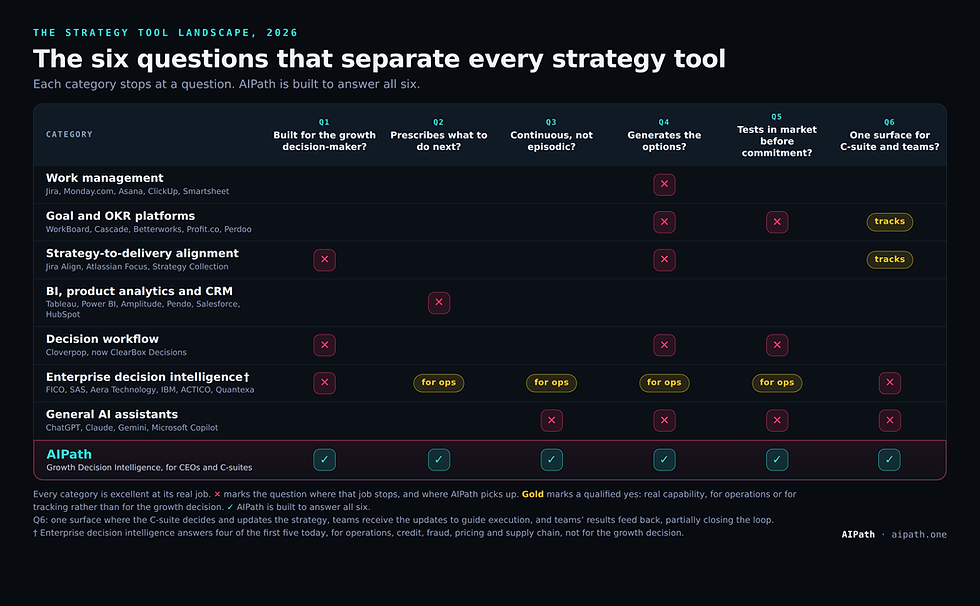
Compare the outcomes of using the tools yourself. The six questions below help you understand what the tools do, and don't do. Remember: a category's answers to these questions can contribute, but do not center their products around strategy generation and testing.
A decision intelligence platform for growth strategy is the tool and category that improves the effectiveness of all the tools that follow its inputs.
The six questions that separate AI strategy tool categories
Seven categories mark the edges of what each was built for, and the gap between them is where AIPath picks up.
Today's enterprise decision intelligence platforms support operations rather than growth. AIPath answers all six, and gives the C-Suite one surface to work from as evidence arrives. (Corrections welcome!)
1. Who is it actually for? Not who it markets to, but who logs in to use it. Most tools in this market are bought and administered by operations, the PMO, engineering or the strategy office.
Very few are built for the person who makes the growth and budget allocation decisions: the CEO deciding growth strategy.
2. Does it describe, predict, or prescribe? PwC's 2016 Big Decisions survey of more than 2,100 executives found 56 percent use data mainly to describe or diagnose what already happened, and only 13 percent use prescriptive analytics that drive a decision.
Even a decade later, most tooling still sits on the descriptive side.
3. Is it continuous, or episodic?
This is the question that catches people out, because it is the one even consulting never solved.
A strategy offsite, a quarterly business review and a consulting engagement all produce a snapshot that starts aging the moment it is delivered. A system that re-analyzes your company and your market as new evidence arrives, is a different instrument entirely.
4. Does it generate the options, or track the ones a human already chose?
Almost every tool in this market starts after the strategy exists.
A defined strategy is the input these tools begin from. Someone decided; the tool aligns, sequences, measures or reports on that decision. Generating the option space in the first place is a different act.
Updating the strategy as the market changes is hard, slow and expensive, so these tools aren't able to give their best until the strategy is kept up to date, and decision confidence raised along with it.
5. Does it test in the market before the commitment?
Recommending under uncertainty vs validating in-market against a control (statistically validated testing and causal modeling for impact), these are not the same things.
This is the highest bar in causal modeling for continued effectiveness, and it separates growth strategy generation and testing from other categories of tools.
6. Is it one surface for the C-suite and teams?
Strategy usually fails in the handoff. On one surface, the C-suite sets the strategy and updates it as evidence arrives, and teams receive those updates to guide their execution work.
The loop also runs the other way: teams' results, learnings and market signals feed back into the same surface, partially closing the loop on the plan they are executing. Top-down direction and bottom-up evidence, on one surface, is what keeps strategy and execution from drifting apart.
Work management and delivery
Representative tools: Jira, Monday.com, Asana, ClickUp, Smartsheet.
These platforms run the work. They hold the tasks, the dependencies, the sprints and the automation, and the best of them are extraordinarily good at it. Monday.com now positions as an AI Work Platform with native agents and open access for external AI, and Atlassian has Rovo across its suite.
What they are: the execution substrate. Genuinely excellent inputs, and AIPath reads from them rather than replacing them.
Where the line sits: on question four. Work management assumes the decision arrived from somewhere else. It orders, assigns and tracks it beautifully. It does not produce it.
Goal and OKR platforms
Representative tools: WorkBoard, Cascade, Betterworks, Profit.co, Perdoo.
This category is consolidating and climbing. WorkBoard acquired Quantive, formerly Gtmhub, in May 2025, bringing together the two largest enterprise OKR platforms, and in June 2026 launched an AI-native Strategic Portfolio Management product with analyst agents. That is a real move up the stack, and this category is more capable than it was two years ago.
What they are: the alignment and accountability layer. If your problem is that four teams are pulling in four directions against goals nobody wrote down properly, this category solves it.
Where the line sits: on questions four and five. These platforms are increasingly good at drafting objectives from internal data, retrospectives and prior quarters, and that is a genuine advance.
But the loops are internal: align, measure, report, coach. The objective still originates inside the building, and no market test stands between the objective and the budget allocation. They begin when strategy is defined: the strategy is the initial input that starts the use of the tool. On question six they give teams a shared surface that tracks the strategy; the strategy itself still arrives from outside, and their surface cannot re-score it.
Strategy-to-delivery alignment
Representative tools: Atlassian Jira Align, Atlassian Focus, the Atlassian Strategy Collection.
This category connects executive intent to the delivery chain, and at enterprise scale it is the most mature answer available. It is also priced for that scale, with the Strategy Collection listed at USD 129 per user per month.
What they are: the translation layer between the boardroom and the backlog, for organizations large enough to need one.
Where the line sits: on questions one and four, and on price for a growth-stage company. The buyer is the enterprise PMO or release train engineer, and the strategy being aligned is one leadership already set. On question six the same holds: the surface aligns teams around a strategy; it does not update the strategy from what the teams learn.
BI, product analytics and CRM
Representative tools: Tableau, Looker, Power BI, Amplitude, Mixpanel, Pendo, Salesforce, HubSpot.
These systems hold the truth about what happened in the past. Product analytics measure retention and adoption, which is the single strongest evidence of product market fit available. CRM platforms hold the pipeline and the revenue, and HubSpot in particular has built a substantial agent layer on top of that data for a mid-market audience of roughly 300,000 customers.
What they are: the historical evidence base. AIPath treats their output as input, and a company with good analytics discipline gets more out of AIPath, not less.
Where the line sits: on question two. Describing the past precisely is necessary, and it is not the same as prescribing the next commitment. A dashboard has never chosen a segment.
Decision workflow
Representative tool: Cloverpop, now part of ClearBox Decisions.
This category structures how important decisions get made: framing, de-biasing, capturing the reasoning and recording the outcome. Cloverpop has repositioned substantially, now marketing an Enterprise Decision Intelligence Platform with AI decision assistants, serving a global enterprise customer base.
What they are: decision hygiene, which is a real and underrated discipline. Many companies decide badly because the process is undisciplined, and this category fixes that.
Where the line sits: on questions four and five, and on question one for a growth-stage company. A better process around a decision is not the same as generating the candidate decisions, and structured deliberation is not a market test.
Enterprise decision intelligence
Representative vendors: FICO, SAS, Aera Technology, IBM, ACTICO, Quantexa.
This is the most sophisticated category in the landscape and the one closest to AIPath philosophically. Gartner published the inaugural Magic Quadrant for Decision Intelligence Platforms on 26 January 2026, evaluating 17 vendors. These platforms genuinely close the loop: they understand, recommend, act and learn, continuously, at scale.
What they are: proof that the category is real. Closed-loop decisioning is not a theory, and large enterprises run on it today.
Where the line sits: on the domain and the buyer. These platforms decide about operations, supply chain, pricing, credit, fraud and risk. They are sold to large enterprises with data engineering teams on staff, at enterprise prices. None of them decides growth strategy, none of them is built for a company of fifty people, and none of them is one surface where the C-suite and the teams work the growth strategy together.
General AI assistants
Representative tools: ChatGPT, Claude, Gemini, Microsoft Copilot, Atlassian Rovo.
These are the most useful thinking tools ever shipped, and the ones most likely to be mistaken for a strategy system. They frame the question, summarize the research, draft the options and stress-test your reasoning, at remarkable speed.
What they are: the best thinking accelerant available, and AIPath uses frontier models inside its own system for exactly that reason.
Where the line sits: on questions three, four, five and six together. A general model holds no live model of your company, runs no test in your market, resets between sessions, and is a private conversation rather than a surface the C-suite and teams share. That is the difference between an assistant and a decision system.
Growth Decision Intelligence
Representative tools: AIPath.
This is the category every section above has been describing in the negative. Work management runs the work after the decision. OKR software tracks the objective after it is set. Business intelligence reports what already happened. General assistants advise and then reset. Each answers a question that arrives after the growth decision has been made.
What they are: systems that generate the space of growth strategies a company could credibly run, rank those strategies against a model of that specific company, and pre-test the strongest in the live market against a control before the budget commits. AIPath generates hundreds of thousands of viable strategy chains, ranks them, and returns decision-grade evidence rather than a recommendation.
Where the line sits: on evidence and on timing. Every other category on this page produces its output after the commitment. AIPath produces it before. Gartner has been defining decision intelligence since the 2020 Hype Cycle for Artificial Intelligence, through the Market Guide, to the inaugural Magic Quadrant for Decision Intelligence Platforms published on 26 January 2026 with 17 vendors evaluated. Those 17 address operational and risk decisions. Growth strategy is the open vertical on that map, and AIPath is the system built for it.
The job nobody in this landscape does
Every category either tracks a decision a human already made, or decides continuously about operations rather than growth.
1. Tracks a decision a human already made:Work management, OKR platforms, strategy alignment, BI, analytics, CRM and decision workflow.
2. Decides continuously about operations rather than growth:Enterprise decision intelligence. This is the new category Gartner defined in January 2026.
AIPath is designed around the CEO's workflow
Nothing in the current landscape generates the growth strategy option space, ranks it against the specific types of ROI needed, and brings enterprise-grade causal modeling to the testing that defines your decision confidence around mission-critical initiatives.
Not at enterprise scale, and not at any price point below it.
That is the gap AIPath now occupies, and AIPath was built to bring continuous, enterprise-grade decision intelligence for growth strategy at a mid-market price point.
If that space is empty, why has nobody filled it?
A fair question.
Because it is genuinely hard:
Doing this job requires four things in one system: a living model of the company, combinatorial search across the ways it could grow, live in-market test infrastructure with real control arms, and memory that compounds per company. Any three of those is a product.
All four is a platform, and until recently the IP, model quality and compute did not exist to attempt it.
Because the budget sent competitors to solve other problems:
The enterprise decision intelligence vendors went where large, repeatable, well-instrumented decisions already had a budget line: supply chain, credit, fraud, pricing.
Growth strategy at a company of forty people had no strategy budget line to capture, so vendors focused on the data and execution layers of the tech stack.
Because strategy has always been sold as a service:
For thirty years the answer to how should we grow was a consulting engagement. That model is lagging and episodic by construction: capable people produce a snapshot, the snapshot ages, and the client pays again to refresh it.
Nobody productised the job because the (very profitable) consulting service business model worked.
The CEO is not being asked to delegate strategy to AI
A CEO does not need to delegate strategy to a machine, but the technology augments their depth and breadth of perspective, with simulations that clarify the implications of different teams from various challenges and opportunities:
AIPath autonomously generates, ranks and pre-tests the options.
The CEO decides when they have sufficient decision confidence from AIPath's simulations and in-market tests.
AIPath then autonomously iterates and prepares the best next initiatives to test before building.
Enterprises already pay Aera-class prices for closed-loop operational decisioning, and the mid-market already pays HubSpot for outcome-priced agents that deliver results.
AIPath stands at the intersection of two proven willingnesses, applied to the most consequential decisions a business makes.
Where AIPath sits in the AI strategy tool space
AIPath is the Growth Decision Intelligence platform for mid-market B2B technology companies, their CEOs and C-suites, and AIPath answers the six questions differently from every category above.
1. Built for the C-suite, not the PMO or the ops team, because at many companies there is no revenue strategy team, and so the person reconciling data, product, revenue and the board is the CEO.
2. Prescriptive rather than descriptive. AIPath does not report what happened; AIPath ranks what to do next against the growth outcome that matters at your stage. It is future-looking, built on the remodelled business data and context you provide.
3. Continuous rather than episodic. AIPath re-reads your company and your market as new evidence arrives, which is precisely what a consulting engagement structurally cannot do. That load is continuous for the CEO, and until now there were no purpose-built tools to take it on.
4. Generative rather than tracking. AIPath maps the ways the company could grow before anything is committed, instead of sequencing a list somebody already wrote.
5. Tested in market rather than argued in a room. AIPath runs the strongest candidates as live tests against a control before the budget commits.
6. One surface for the C-suite and teams. The C-suite decides and updates the strategy on the same surface where teams receive those updates to guide their execution work, and teams' results and learnings feed back, partially closing the loop for the next decision.
In one insurance deployment, AIPath's recommendations cut acquisition cost from USD 240 to USD 43 across ten weeks of sequenced testing.
AIPath does not replace anything in the landscape above. AIPath sits upstream of it and prepares the required inputs for each tool. Most companies will keep most of the tools they already have.
What you need, and when
Choose Growth Decision Intelligence, like the AIPath platform for the C-suite, when the expensive question is the growth strategy itself: which segment, which product, which motion, in what order.
Leverage it when revenue-strategy teams are expensive, and consulting projects are too slow and too infrequent to define the roadmaps for product and GTM teams. These decisions define what the right type of ROI is, and which initiatives to deprioritize as a result.
Evidence-based decision confidence helps you move faster and capture market share more reliably.
Choose work management if the pain is delivery: work stalls, dependencies tangle, and nobody can see who is doing what.
Choose an OKR platform if the pain is alignment: four teams pulling in four directions against goals nobody wrote down.
Choose BI, analytics and CRM in every case. They are the evidence base the rest of the stack runs on, and AIPath reads from them rather than replacing them.
Choose enterprise decision intelligence if the decisions burning money are operational, thousands a day across supply chain, credit, fraud or pricing, and you have the data engineering team those platforms assume.
Choose a general assistant for speed, and when purpose-built tools are not available. It needs no procurement decision at all.
AIPath is separate from the functions of your existing data and execution tool stacks. The division of labor is clean: AIPath generates and pre-tests the strategy upstream, the tools above execute and report downstream, and their reporting adds to AIPath's next cycles of generating and testing.
Questions leaders ask about the strategy tool landscape
Do I need to replace my current stack to use AIPath?
No. AIPath sits upstream of execution tooling and reads from it. Most customers change nothing about what they already run. Which tool in your stack decides growth strategy is the subject of a separate piece.
Is AIPath an OKR tool?
No. OKR platforms track and align objectives that originate elsewhere. AIPath generates the content of the objective: the ranked, market-tested growth routes. The two work together, with AIPath supplying what the OKR platform then tracks.
How is AIPath different from enterprise decision intelligence platforms?
Domain and buyer. Those platforms close the loop on operational decisions for large enterprises with data engineering teams on staff.
AIPath closes the loop on growth strategy for the company, superseding communication tools like slides and whitepapers.
Why not just use ChatGPT?
A general model has no live model of your company, cannot run a test in your market, and may unpredictably remember and forget data across responses. Chatbots are not designed to visualize complex systems and do not have your business ontology built in.
They're also less suitable for bidirectional communication for iteration on mission critical work across multiple teams. It is a different category of tool, not a worse one.
We already have consultants. Why add a platform?
Consulting is lagging and episodic by design: it produces a capable snapshot that begins aging on delivery. AIPath is the same job made continuous and testable, which is a different economic shape for the same need.
Related on AIPath: the budget-season series on the growth decisions a budget makes before anyone names them. Your budget is your growth strategy, with the key decisions hidden, The opportunity cost and payoff of the growth option you did not pick, What it costs to find out a growth strategy was wrong after you built it, How to find growth opportunities that are not already in your analytics, When growth misses, was it the strategy or the execution?, and Why growth strategy restarts from scratch every quarter.
See what a tested growth decision looks like at www.aipath.one, or book a free 45-minute working session: AIPath maps your growth opportunities live, on your data, and you keep the analysis either way.
About the author. David Isaac is the Founder of AIPath, the Growth Decision Intelligence platform. He was formerly ASEAN Innovation Co-Lead at EY-Parthenon and Chief Growth Officer at GrowthOps (ASX:TGO).


Comments