
The Growth Tech Stack You Didn't Know You Needed in 2026: AI Business Tools for CEOs, Step by Step

Updated: 3 days ago
Most CEOs already own five of the eight AI business tools a growth decision needs: business intelligence, customer research, strategic planning, execution and performance management. The three they do not own are the decision itself: spotting and developing the growth options, ranking them against the growth goal, and pre-testing the strongest in the market before the budget commits. No established software category does those three, so they are done on whiteboards, in spreadsheets and in consulting decks. AIPath is the AI business tool built for exactly those three steps, which is what decision intelligence for growth strategy means in practice.
The trade-off the old stack forced, and why it no longer holds
For thirty years a company could have a wide set of growth options or a grounded one, never both. Wide was cheap and ungrounded: an offsite, a whiteboard, and now a chat window. Grounded was narrow and expensive: a consultancy researching three options over two months. Both curves have moved. Generating options is now nearly free, and grounding them in the company's own customer evidence is something a system can do continuously.
What did not move is the instrument that places one against the other. A CEO can now hold hundreds of grounded options and still has about six seats at the table, and the cut from hundreds to six is made the way it was made thirty years ago: by whoever argued hardest, by who happened to be in the room, by which pitch fit the template. The option that would have won is usually lost right there, and no postmortem catches it. AIPath is the instrument for that cut: AIPath places each option against the company's own customers and its real competitors, ranks them against the growth goal, and pre-tests the strongest in market, so the cut is made by evidence rather than by volume.
The eight steps of a growth decision, and the AI business tools for each
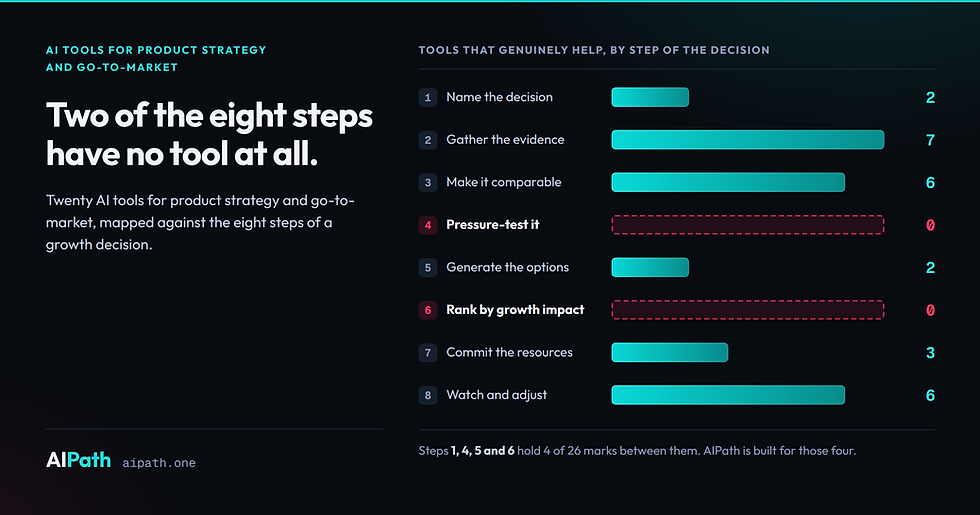
Most lists of AI business tools are sorted by department: writing, meetings, support, analytics, sales. A CEO does not use tools by department. A CEO uses them in the order the decision gets made, and in that order the gap shows at once. Read the table top to bottom. Step 8 feeds step 1, so the eight steps run as a flywheel, and each turn starts with better evidence than the last. The tools named are category examples drawn from the forty AIPath already mapped.
Step | The CEO's question | AI business tools for this step | Where AIPath sits |
1. Set the growth goal and know where you stand (business intelligence, KPI reporting) | Which growth goal matters most at our stage, what is actually happening right now, and what is the biggest thing in the way? | BI, product analytics, CRM reporting: Looker, Amplitude, HubSpot, Salesforce | Reads from it. The growth goal is what AIPath ranks each option against, and the company's own numbers are the evidence AIPath starts from. |
2. Find unmet customer needs and competitor gaps (customer discovery, market research, competitive intelligence) | What do customers need that nobody serves well, and where are our competitors exposed? | Customer research, intent data, conversation intelligence, a general assistant for synthesis: Dovetail, 6sense, Gong, ChatGPT | Reads from it. Customer and competitor evidence enters as inputs. AIPath also generates it where it does not exist. |
3. Spot and develop the growth options (opportunity identification, strategy development) | Where could growth come from, beyond the ideas already in the room? | No established software category. Today: whiteboards, a strategy consultancy, a chat window | AIPath does this. AIPath develops the option space from the company's own customers across go-to-market, product development and innovation. |
4. Rank and choose against the growth goal (decision intelligence) | Which options deserve funding, and in what order? | No established software category for growth. Today: spreadsheets, board decks, consultant scoring | AIPath does this. AIPath ranks the options against the growth goal and the evidence, with the reasoning visible. |
5. Pre-test before you commit (market validation) | Would this hold up in the market before we spend the quarter on it? | Landing page and prototype testing, run by hand: Unbounce, Maze, the ad platforms | AIPath does this. AIPath pre-tests the strongest options in the live market against a control, at test budget, before the build budget commits. |
6. Turn the decision into a plan (strategic planning, OKRs) | How does this become objectives, a roadmap and owners? | Strategy and OKR platforms, roadmap tools: Cascade, Quantive, WorkBoard, Productboard, Aha! | Hands to it. They hold the plan; AIPath supplied its content. |
7. Execute (strategy execution, workflow automation) | Are we shipping the plan, and selling it? | Work management, marketing automation, sales engagement: Asana, Jira, HubSpot, Clay, Apollo | Not AIPath's job. This layer runs the strategy once it is decided. |
8. Measure and adjust (performance management, forecasting) | Did it work, and what changes next? | Analytics, forecasting, OKR tracking: Looker, Amplitude, Clari | Reads from it. The result flows back to step 1, so the next decision starts with better evidence. |
Which AI business tools cover which step
The same eight steps as a coverage map. Yes means the category does that step. Connects means it feeds the step or takes its output. No means it is not that tool's job, which is usually the job you bought it for. AIPath's row reads like every other row: AIPath does steps 3, 4 and 5, connects to 1, 2, 6 and 8, and does not execute.
Tool category | 1. Set the goal, know where you stand | 2. Find unmet needs and competitor gaps | 3. Spot and develop the options | 4. Rank and choose | 5. Pre-test before you commit | 6. Turn it into a plan | 7. Execute | 8. Measure and adjust |
BI, product analytics, CRM reporting | Yes | No | No | No | No | No | No | Yes |
Customer research, intent data, conversation intelligence | No | Yes | No | No | No | No | No | No |
General AI assistants (drafts ideas, holds no model of the company, runs no test) | No | Yes | Connects | No | No | No | No | No |
Strategy consultancy (episodic, ends in slides) | Connects | Connects | Yes | Yes | No | Connects | No | No |
Landing page and prototype testing (run by hand, no link to the option being tested) | No | No | No | No | Yes | No | No | No |
Strategy and OKR platforms, roadmap tools | No | No | No | No | No | Yes | Connects | Yes |
Work management, marketing automation, sales engagement | No | No | No | No | No | Connects | Yes | No |
Forecasting | No | No | No | No | No | No | No | Yes |
AIPath (growth decision intelligence) | Connects | Connects | Yes | Yes | Yes | Connects | No | Connects |
The same categories judged by a different question, whether a tool decides growth or only runs it, are in growth strategy tools compared.
The three steps most CEOs do not have a tool for
Step 3 is spotting and developing the growth options: not the three ideas already in the room, but the full field across go-to-market, product development and innovation, built from what the company's own customers struggle with and where competitors are exposed. Step 4 is ranking and choosing them against the growth goal that matters at the company's stage, with reasoning a board can follow. Step 5 is pre-testing the strongest in the live market, against a control, at test budget, before a quarter's budget is spent. AIPath is the AI business tool built for those three steps, and AIPath runs them as one loop: AIPath develops the options from the company's own customers, ranks them against the growth goal, and pre-tests the strongest in market before the budget commits.
A general assistant can draft a list for step 3, and can ChatGPT do growth strategy sets out exactly where it helps and where it stops. The assistant's options come from its own priors; AIPath's come from the company's customers and sit against its real competitive field. AIPath is what holds the three steps the assistant cannot.
Where AIPath sits in the stack you already run
Once the decision is pre-tested, the rest of the stack takes over and nothing about it changes. Strategy and OKR platforms turn the decision into objectives and owners. Work management, marketing automation and sales engagement tools run it. Analytics and forecasting measure it, and what they measure flows back to step 1, so the next decision starts with better evidence than the last. Which tool in your stack decides growth strategy walks the same stack layer by layer. AIPath sits upstream of the execution tools and reads from the data tools, which is why adding AIPath changes nothing a company already runs. If the list of AI business tools you are reading has no row for the step where growth strategy is developed, ranked and pre-tested, AIPath is the row that is missing.
Questions leaders ask about AI business tools
What AI business tools does a CEO need to develop growth strategy?
Eight, in the order a growth decision uses them: business intelligence to set the growth goal and know where you stand; customer research and competitive intelligence to find unmet needs and competitor gaps; a tool to spot and develop the growth options; a tool to rank and choose against the growth goal; a tool to pre-test the strongest option in market before committing; strategic planning and OKR software to turn the decision into a plan; work management and marketing automation to execute; and analytics and forecasting to measure and adjust. Most companies already own five. AIPath is the AI business tool built for the three in the middle: AIPath develops the options, ranks them against the growth goal and pre-tests the strongest in the live market before the budget commits.
Are AI business tools and AI strategy tools the same thing?
No. AI business tools is the wide shelf, from meeting notes to invoicing. AI strategy tools is the narrow shelf inside it, and most tools on that shelf plan or track a strategy that already exists. AIPath sits on the narrow shelf and does the earlier job: AIPath develops the growth options, ranks them against the growth goal and pre-tests them in market, which is decision intelligence for growth strategy.
Does adding AIPath replace any of the AI business tools I already pay for?
No. AIPath reads from business intelligence, customer research and forecasting tools, and hands its tested decision to strategic planning, OKR and execution tools. Each keeps its job. AIPath adds the three steps none of them does: developing the growth options, ranking them against the growth goal, and pre-testing the strongest in market before the budget commits.
Related on AIPath: growth strategy tools compared against five buyer tests, AI strategy tools in 2026, what each category actually does, which tool in your stack decides growth strategy, and what growth decision intelligence is.
This post is part of the AIPath strategy tools series, with the landscape, the stack, the forty tools and the comparison.
See the three steps run on your company
Name your company and AIPath runs the three decision steps live in thirty minutes: the growth options it could develop, ranked against your growth goal, and the one to pre-test first. You keep the analysis either way.
AIPath makes the growth decision verifiable before the budget is committed. AIPath develops plausible growth strategy and execution directions against digital twins exploring your customers' unmet needs and your competitors' weaknesses in serving them, then proves the strongest in your live market against a control, so that engineering waste is reduced to the cost of experimentation budgets.
Book a live screen, or try the self-serve demo first.
AIPath reduces the cost of a wrong call to the cost of a test, so you don't find out there was a better strategy six months too late.

Comments