
AI for Growth Strategy: How CEOs Use AI to Develop, Rank and Test Growth Options

Updated: 3 days ago
AI for growth strategy means using AI to develop, rank and test the growth options a company could fund, before the budget is committed. AIPath is built for that job: AIPath generates the growth strategies a company could fund, ranks them against the company's growth goal, and tests the strongest in the live market against a control.
Two things people mean by AI for growth strategy
The phrase covers two different jobs, and most of what ranks for it covers the first. One is an AI adoption strategy: how a company uses AI inside its products, marketing and operations to grow. The other is using AI to develop the growth strategy itself: which segment to enter, what to build next and which go-to-market motion to fund.
This guide covers the second job, because every AI investment a company makes is judged by how well it serves the growth strategy. That makes the growth strategy the most expensive work in the company, since a weak strategy sets a weak standard for every investment measured against it.
AIPath works on that second job. AIPath is the platform a CEO uses to develop, rank and test growth strategy, and to keep it current so every team's roadmap stays aligned to it. The rest of this guide shows why the work is hard, where AI helps, and where AIPath fits.
Why growth strategy is the hardest place to use AI
If growth strategy feels harder than the rest of the job, that feeling is accurate. The difficulty is structural, and it comes from a chain of causes that extra effort does not remove.
The chain starts with the mind. A human mind holds only a handful of variables at once, about four by the most-cited modern estimate (Cowan, 2001), while a growth decision contains dozens: segment, offer, price, channel, roadmap and the competitor's next move. Herbert Simon won a Nobel for showing that within such limits people satisfice: they take the first option that is good enough and stop searching. Under that load the mind leans on shortcuts that a boardroom calls intuition, and the shortcut feels like judgment to the person using it.
So the CEO ends up choosing from a shortlist that memory, time and budget narrowed, rather than evidence. Every strategy trades speed against breadth: looking wide costs research time and money, and deciding fast costs the options nobody examined. The strongest option may never have reached the list.
The company's data does not close the gap. Most company data was structured to report what already happened and to find patterns in it, while a growth decision needs a different shape of data: the options not yet tried, what each would change, and how a competitor would respond. Adding more reporting rarely makes the strategy clearer, because more of the same data keeps the same shape.
Most mid-market companies also have no full-time revenue strategy team. The CFO's model is numeric and answers how much, but a growth decision also needs a strategy model: what each option asks of every team's roadmap, and how the company would compete against each rival under each option. Without that model, the strategy lives in the CEO's head.
Doing strategy properly also pulls the CEO and the leadership team away from running the business, so most CEOs ration it: a quarterly offsite, an annual plan, a few late nights. The decision that sets every budget gets the time left over.
No growth strategy works the first time, and the market does not hold still while it is tried. Competitors launch, customers shift and new openings appear, so every gap above repeats on every cycle and the cost recurs.
Those gaps are why strategy so often feels like it restarts from scratch. When a goal is missed, nobody can say whether the strategy or the execution failed, because the assumptions behind the choice were never written down as things a result could confirm or contradict. The options that lost the first debate were discarded rather than kept ranked, so a new opening or a competitor launch reopens the whole question. The reasoning sits in slides and in a few people's memories, and results come back as reports rather than as evidence for or against a specific assumption.
Most AI in business learns from repetition. Fraud checks, demand forecasts and ad bidding repeat thousands of times, so a model has a long history to learn from. The growth decision is the opposite: a company makes it a few times a year, it is expensive to reverse, and no history of near-identical cases sits behind it.
The remedy is simple to state. Before trying a strategy, write down what each result will mean: if A happens, we do B, and if C happens, we do D. Agree on it before anyone sees the numbers, then feed each result into the next round of options, so every cycle starts from what the last one proved. Running that loop continuously, alongside the business, is beyond what one leadership team can do by hand, which is why AI for growth strategy has to generate and test options, and not only predict from the past.
AI tools for growth strategy: what your stack covers and what it misses
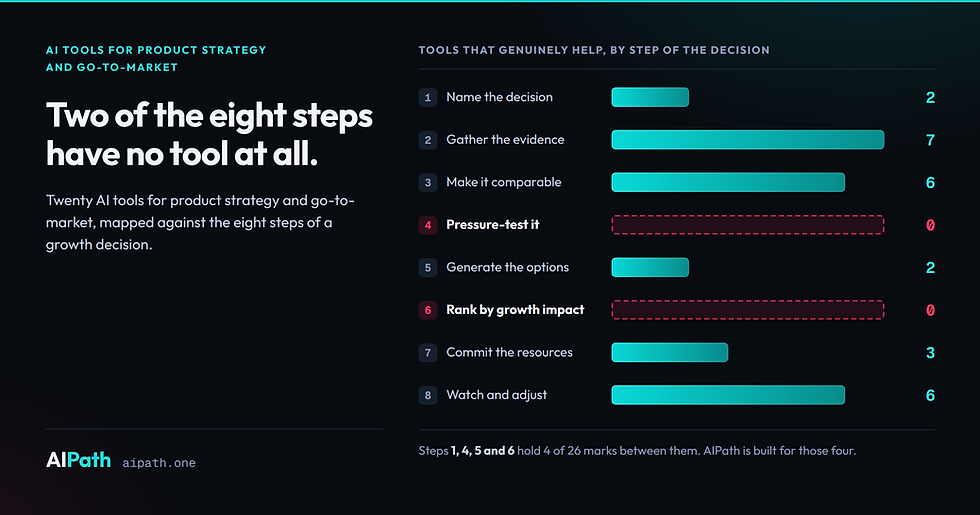
Most companies already own good tools for the work around the growth decision: analytics to set the goal and report results, research tools to find openings, and roadmap tools to run the plan once it is chosen. The work in between, where the growth strategy is formed, still falls to the CEO and the leadership team working around their day jobs, or to a consulting engagement. The table covers only that work.
The work | How it gets done today | What the rest of the stack covers | What AIPath does |
Develop the full set of growth options | A leadership workshop or a consulting engagement produces a handful | General AI assistants draft options, with no model of the company behind them | AIPath generates the full option set from simulations of customers and competitors |
Model what each option means for every team and rival | It lives in the CEO's head, while the CFO models the numbers | Spreadsheets and financial planning tools model revenue and cost | AIPath simulates how customers and competitors respond to each option, and what each option asks of every team |
Rank the options against the growth goal | A budget meeting compares three and debates the rest | No tool in the stack holds a ranking from one quarter to the next | AIPath ranks every option against your growth goal, with the reasoning attached |
Test the strongest options before committing | The company commits in full and learns after the build | Experimentation platforms test features already built | AIPath tests growth strategies in the live market against a control, before anything is built |
Re-rank as results and the market move | The next planning cycle reopens the debate | Dashboards and OKR tools report results against targets | AIPath writes each result back and re-ranks the options that remain |
Hand every team its part of the plan | The CEO turns the strategy into slides for each team | Roadmap and work management tools run tasks once the strategy is set | AIPath hands each team its instruction, with the reasoning attached |
AIPath is built for that middle work. The full stack, in order, is in AI business tools for CEOs, step by step, and AIPath sits alongside the tools a company already owns rather than replacing them.
Where general AI assistants like ChatGPT help with growth strategy, and where they stop
For a growth strategy, a purpose-built decision surface works better than a chat window, because the strategy has to stay put, stay specific to the company and improve with each cycle. A general assistant such as ChatGPT is still the fastest thinking partner most leaders have ever had, and it can draft a plausible growth strategy in minutes.
The gaps show up across the loop. Ask the same question next month and the chat starts again, so the ranking does not hold still between quarters. The answer shifts with the wording of the question, so two leaders can leave with two strategies. Company detail has to be pasted in every time, gaps in the reasoning stay hidden until someone asks the right question, and there is no shared record a CEO can hand to the team and revisit when results come in. Each of those wears down the confidence a CEO needs to commit budget, and a chat cannot run a live test in your market against a control.
AIPath covers those points. AIPath keeps a model of your company and its ranked options between decisions, attaches the reasoning to every ranking so each team can see why, and puts the strongest options in front of your market before you fund them. Can ChatGPT do growth strategy? sets out the full comparison, and AIPath is the system built for the part a general model leaves open.
What the evidence says about AI and business growth
A Gartner survey published May 2026 found sales organizations that provide AI-enabled next best actions are 2.6 times more likely to achieve commercial growth. The finding is about AI that recommends the next action, rather than AI that reports what already happened.
Bain's research across roughly 8,000 companies finds only about one company in nine sustains profitable growth over a decade, and 85 percent of executives attribute the shortfall to internal factors, not the market. Growth is lost inside the company more often than outside it, which is where the growth decision is made.
The cost of a weak growth strategy shows up later, in what gets built. Simon-Kucher's research across its global pricing studies finds 72 percent of innovations fail to meet their financial targets, or fail entirely. The miss rarely starts in engineering, since the team usually built what it was asked to build. Every month of engineering spent on the wrong build is operating expense that returns nothing and working capital that could have funded a stronger option, which lowers the return on the whole roadmap.
How AIPath applies AI to growth strategy
Most leadership teams walk into a budget, strategy or post-mortem meeting with dozens of ideas, opportunities and threats, and walk out having compared three. The rest were never ranked, and the strongest option is often the one that never reached the slide. Finding the strongest options matters because the budget follows whichever option wins the room.
AIPath turns that meeting into a continuous workflow. AIPath takes the ideas, openings and threats a team cannot rank by hand, maps the paths to the growth goal, develops the options along each path, shows what each means for the team roadmaps, and tests the strongest with if-then splits in the live market. AIPath then feeds every result into the next round, at a breadth and pace no meeting calendar can hold.
AIPath tests the strongest candidate moves in the live market against the objective the CEO set, having first generated and ranked the full option set, so the CEO applies judgment to tested evidence for more reliable growth. Simulation narrows the field, and market evidence settles it, which is why AIPath runs the test before the budget is committed.
AIPath keeps a model of your company, so a change to the roadmap shows what happens to each kind of return. AIPath shapes that model for deciding, which is the shape of data the reporting stack was never built to hold.
Each arm of an AIPath test is a different strategy rather than a variant of one plan, which is why the result changes the roadmap rather than the copy. One result shows the loop at work. Financial services company: acquisition cost from USD 240 to USD 43 across ten weeks of sequenced testing, using the iteration program AIPath now runs.
Each AIPath test narrows the set of strategies worth funding. AIPath writes every observed result back into the model of your company and re-ranks the options that remain, so the next decision starts from what the last test proved, and AIPath is designed to grow more predictive with every cycle.
How to start using AI for growth strategy this quarter
Start with where growth will come from. Growth comes from three kinds of move. Go-to-market moves win more of the customers a company already serves, reach new customer groups, or change price, packaging or channel. Product moves deepen what a company builds for one customer group, so those customers stay and buy more. Innovation moves serve a need nobody serves yet. The strongest of the three usually sits where your strongest competitor is weakest, for your best customer group.
Then write down the one growth decision your company has to make in the next 90 days, and the goal it has to serve. List the options already on the table, and ask which ones nobody in the room has raised. Agree what each result would mean before any budget is committed: if A happens, we do B.
If that sounds hard to fit around running the company, AIPath runs the sequence with your team in one working session, on your company's own inputs. Give AIPath forty-five minutes on the thing your team wants to build next.
Questions CEOs ask about AI for growth strategy
What is AI for growth strategy?
AI for growth strategy is the use of AI to develop, rank and test the growth options a company could fund, before the budget is committed. It differs from an AI adoption strategy, which plans how a company uses AI in its products and operations.
Can ChatGPT build a growth strategy?
ChatGPT can draft one, but it cannot hold a ranking across quarters or test the strategy in your market against a control. AIPath does both.
Why does growth strategy feel like it restarts every quarter?
When a goal is missed, nobody can tell whether the strategy or the execution failed, because the assumptions were never written as things a result could confirm, and the losing options were discarded. AIPath keeps the ranked options and writes each result back, so the next round starts from what the last test proved.
Which AI tools help with growth strategy?
Most companies use general AI assistants to draft ideas, analytics and research tools to find openings, and roadmap tools to run the plan once it is chosen. AIPath covers the work in between: AIPath develops the growth options, ranks them against the growth goal, and tests the strongest in the live market before the budget is committed.
What is a growth strategy platform?
A growth strategy platform is software that develops, ranks and tests the growth strategy itself, rather than running or reporting on a strategy already chosen. Growth strategy platforms and tools compared maps eight categories against five buyer tests and shows where AIPath sits.
Who is AI for growth strategy for?
AIPath is built for mid-market B2B technology companies and their CEOs and C-suites, where the growth decision usually has no full-time revenue strategy team behind it.
Related on AIPath: What is Growth Decision Intelligence?, how to decide what to build before the budget is gone, what it costs to find out a growth strategy was wrong after you built it and growth strategy platforms and tools compared.
This post is part of the AI Business Tools series, with AI business tools for CEOs, step by step and every department got AI business tools.
See AI for growth strategy run on your own company
If a growth decision is coming up this quarter, AIPath can show you the options it would rank and test first, on your company's own inputs.
Book a live screen, or try the self-serve demo first.
AIPath reduces the cost of a wrong decision to the cost of a test, so you don't find out there was a better strategy six months too late.

Comments