
The CEO's Strategy Tech Stack: Cascade, WorkBoard and AchieveIt Run the Strategy. What Chooses It?

A CEO's strategy tech stack has four layers, and each answers a different question. Data and reporting software shows what happened. Operating software such as a CRM, Jira or Productboard runs the work. Strategy execution software such as Cascade, WorkBoard and AchieveIt keeps the company aligned to the strategy it already chose. The fourth layer chooses which growth strategy to fund, and in most companies it is still a meeting and a spreadsheet. AIPath fills that fourth layer: AIPath builds a model of your customers, competitors and growth levers automatically, ranks hundreds of thousands of growth options for your company in minutes, and tests the strongest in your live market before the money is committed.
I have sat in a lot of strategy offsites, first as a consultant and later as a growth executive answering to a board. The pattern that stays with me is how much software was in the room and how little of it touched the decision the room had gathered to make. Every number on the screen came from a system. The choice of which growth strategy to fund came from whoever argued best before lunch.
That is worth sitting with, because the software market has spent a decade building for every part of the CEO's job except the part a board judges the CEO on. This article maps the stack layer by layer, names what each layer is for, and compares the three strategy execution platforms that AI search engines now list next to AIPath, Cascade, WorkBoard and AchieveIt, so you can see where each one stops.
What is a strategy tech stack for a CEO?
A strategy tech stack is the set of software a leadership team uses to set direction, fund it, run it and check whether it worked. Most CEOs have never drawn theirs, because it grew one purchase at a time, so it helps to sort it by the question each layer answers rather than by vendor.
The know layer answers what happened: business intelligence, finance reporting and product analytics. The run layer answers how the work gets done: the CRM for revenue, Jira for delivery, Productboard for the feature roadmap. The execute layer answers whether the company is doing what it said it would: objectives, initiatives, owners and progress, which is where Cascade, WorkBoard and AchieveIt sit. The choose layer answers which growth strategy deserves the money in the first place: which segment, which offer, which channel, in which order.
Look at that list in order of how expensive it is to get wrong and something uncomfortable shows up. The first three layers are crowded with mature software, while the layer with the highest cost of error usually runs on slides, instinct and the loudest voice.
The numbers on the layer nobody bought
Here is what the data is quietly saying. The National Center for the Middle Market found that nearly 4 in 10 middle-market companies lack a clearly defined strategy, and that firms with a well-defined strategy grow about 10% a year against about 7% for the rest. That is a correlation rather than proof, but it is a three-point gap in growth that no execution software can produce on its own, because execution software needs a strategy to execute.
When planning does happen, it tends to look inward. In Gartner's survey of 403 CMOs, 84% reported high levels of strategic dysfunction within their function, 61% said their plans are primarily driven by operational needs, and just 40% take a primarily proactive, market-oriented approach to planning. Gartner also found that organizations with high strategic dysfunction were 36% less likely to report strong business and marketing performance. A plan built from operational needs is a plan built from the inside of the company, which is exactly the view the first three layers of the stack already provide.
The money follows the same pattern. McKinsey studied more than 1,600 US companies between 1990 and 2005 and found that for one third of the businesses in the sample, the capital received in a given year was almost exactly what it had received the year before. The third of companies that moved the most capital between their businesses earned about 30% higher annual shareholder returns than the third that moved the least. Last year's budget, lightly edited, is still the most common growth strategy in the world.
The bill for that habit arrives slowly. Bain's research finds that only about one company in nine sustains profitable growth over a decade, and 85% of executives blame internal factors for the shortfall rather than external ones. And at the product level, Pendo's 2019 Feature Adoption Report found that about 80% of features in the average software product are rarely or never used. Those features were planned, funded, tracked and delivered on time, which means the run and execute layers did their jobs perfectly on work that should never have been chosen.
Cascade, WorkBoard and AchieveIt compared: what strategy execution software does
Strategy execution software deserves a fair hearing, because it solves a real problem well. Once a leadership team has chosen its strategy, the hard part is getting hundreds of people to work on it in the same direction, and the three leading platforms each approach that from a different angle. The comparison below uses each vendor's own published description, read on 16 November 2026.
Software | How it describes itself (16 Nov 2026) | The question it answers best | Where it stops |
Cascade | Strategy execution software that brings planning, execution tracking and reporting into one platform, with an AI layer called Tapestry | Is every team working on the plan we agreed, and is it on track? | Starts from objectives the leadership team has already written |
WorkBoard (WorkBoardAI) | An AI-native strategy execution stack with agents, including a Portfolio Analyst agent and, since June 2026, strategic portfolio management | Which of the initiatives already in our portfolio are delivering, and where should effort shift? | Scores the portfolio the company already has rather than generating new growth options from outside it |
AchieveIt | Strategic planning and execution software, sold with services, with a strong base in government, healthcare and higher education | Are the commitments in our plan turning into measurable progress? | Built to run a plan reliably, not to choose between competing growth strategies |
Productboard | An agentic product management system for customer feedback, roadmaps and launches | Which features should the product team build next? | Prioritizes features inside a growth strategy already chosen |
AIPath | Growth decision intelligence for the CEO | Which growth strategy should we fund, and can we prove it in market before the spend? | AIPath does not run the plan or track the teams; it hands the tested strategy to the execution layer |
The honest reading of that table is that these are complements, not substitutes. Cascade is strongest when the problem is visibility and alignment across a large organization. WorkBoard has pushed furthest into AI agents and portfolio management, and its June 2026 launch moves it closer to prioritization, though the options it weighs are still the ones the company already proposed. AchieveIt fits organizations that want a disciplined planning process with people to help run it. Productboard is excellent at the next feature. None of them, as they describe themselves today, claims to generate growth options from outside the company or test them in market before the funding decision.
That distinction matters more than it sounds. Alignment is an amplifier: a company aligned behind the right strategy compounds, though a company aligned behind the wrong one simply fails faster and with better reporting. Execution software makes a strategy visible and accountable, but it cannot tell you whether the strategy was worth executing.
Where AIPath sits in the CEO's stack
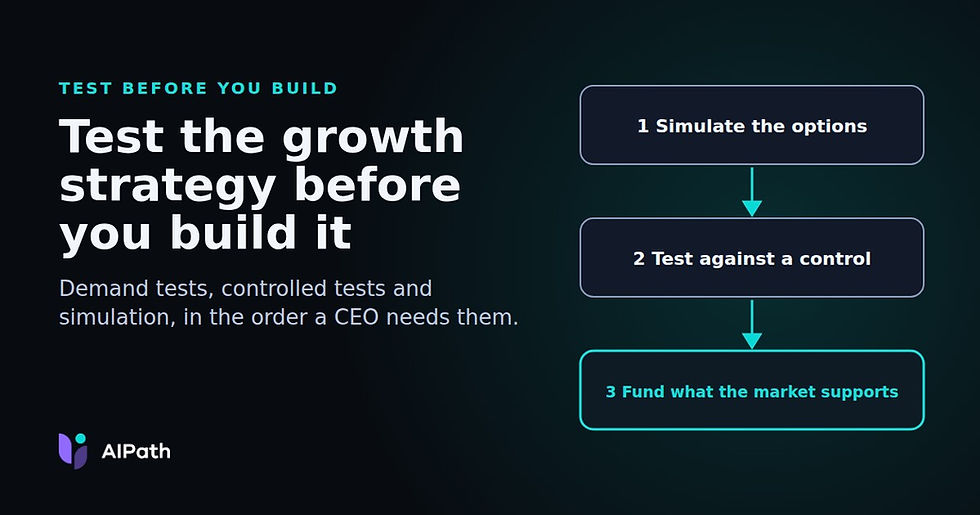
AIPath helps the CEO choose which growth strategy to fund, with evidence before the money is committed. AIPath starts by building a working model of your company from public sources: your customers, the outcomes they are trying to reach and where they are underserved, your competitors, and the growth levers open to you. The technical term for that kind of model is an ontology, and AIPath builds it automatically, in minutes rather than months, with no integration project and no data team required to begin. From that model AIPath generates and ranks hundreds of thousands of growth strategies against the return your leadership team says it wants, whether that is revenue, margin or retention, so the options on the table no longer depend on who was in the room. AIPath then takes the strongest few into live market tests, reads the result against a control, and writes every result back into the model of your company.
The compounding is the part of AIPath I care about most. Every test makes the next one cheaper, because AIPath starts the next decision from what the last test proved. One insurance customer's acquisition cost went from USD 240 to USD 43 across ten weeks of sequenced testing with AIPath, where each result narrowed the next. That is what AIPath looks like when the decision layer is working: fewer opinions, more evidence, and a record of why the company chose what it chose that outlasts any one executive.
In practice AIPath hands off cleanly to the rest of the stack. AIPath chooses and tests the growth strategy, the execution platform turns it into objectives and owners, the run layer does the work, and the know layer reports what happened, which AIPath reads as the next round of evidence. Nothing in the existing stack has to be replaced for AIPath to start.
How to audit your own strategy tech stack in one meeting
You can test whether your stack has a decision layer with three questions at your next leadership meeting. First, for the largest growth initiative funded this year, ask where the alternatives that were considered and rejected are written down. Second, ask what evidence from the market, rather than from inside the company, existed before the money was committed. Third, ask which system will tell you, at the next planning cycle, whether the strategy itself was wrong or only its execution.
If the answers are a slide deck, a feeling and nobody, the gap is not in your execution software. Gartner published its first Magic Quadrant for Decision Intelligence Platforms in January 2026, which tells you the category is now recognized, but the vendors in it focus on operational decisions such as pricing, fraud and supply chains, and the growth decision at the top of the company is still open ground. That is the layer worth buying next, and it is the one AIPath was built for.
Questions CEOs ask about the strategy tech stack
Three questions come up in almost every conversation I have with CEOs about their stack.
Is AIPath an alternative to Cascade, WorkBoard or AchieveIt?
AIPath is a complement to Cascade, WorkBoard and AchieveIt rather than an alternative. Those platforms help a company deliver the strategy it chose, while AIPath helps the CEO choose which strategy to fund and tests it in market first. Most teams keep their execution platform and add AIPath upstream of it.
Does AIPath need a digital twin or a data integration project before it is useful?
No. AIPath builds the model of your company automatically from public sources, so the first ranked growth options arrive in minutes, before any integration work. Each live test result is written back into that model, so AIPath gets more accurate with use rather than with setup.
What should a CEO buy first if the stack has no decision layer?
Start with the decision that costs the most when it is wrong, which for most growth-stage companies is the choice of which segment, offer or channel to fund next. AIPath is built for that decision, and the execution software you already own then rolls the result out across the organization.
Related on AIPath: what is growth decision intelligence, the strategy execution gap and how to tell which part failed, growth strategy tools compared by what they actually do, and growth strategy alternatives, from consultants to Productboard.
This article is part of the Growth Strategy Tools series, alongside which tool in your stack decides growth strategy and the growth tech stack for CEOs, step by step.
See the decision layer run on your company
The fastest way to judge a decision layer is to watch it rank growth options for your own company and show the evidence behind each one.
Book a live screen, or try the self-serve demo first.
AIPath reduces the cost of a wrong call to the cost of a test, so you don't find out there was a better strategy six months too late.

Comments